Determinants
A determinant is a scalar attached to a square matrix. Geometrically, it is the signed volume-scaling factor of the linear map. In two dimensions it scales oriented area; in three dimensions it scales oriented volume; in dimensions it scales -dimensional volume.
The sign tracks orientation. A positive determinant preserves orientation, a negative determinant flips orientation, and a zero determinant means the map collapses space into a lower-dimensional set. That collapse is why determinants connect directly to rank, invertibility, and eigenvalues.
Defining math
For a matrix,
The columns of are where the basis vectors land. The determinant is the signed area of the parallelogram spanned by those two columns.
For a general matrix, the determinant can be defined by expanding along any fixed row :
Here is the smaller matrix formed by deleting row and column from . The factor gives the checkerboard sign pattern
The term is called a minor, and is the corresponding cofactor. Intuitively, choosing fixes how the selected row contributes; the minor measures the remaining volume scaling after that row and column have been removed. The alternating signs correct for orientation, just as the minus sign in the formula subtracts the oppositely oriented contribution.
The same definition can also be written in one compact permutation formula:
Here is the set of all permutations of . A permutation chooses exactly one column for each row , so each product uses one entry from every row and every column. The sign is for an even permutation and for an odd permutation. Equivalently, it records whether the column order chosen by preserves or flips orientation.
These formulas are rarely the best way to compute large determinants directly, but they make the structure explicit: a determinant is a signed sum of full row-column matchings, and the signs enforce oriented volume.
Important consequences are:
The second statement means that a square matrix is invertible exactly when its determinant is nonzero.
Worked example
Take
Its determinant is
So multiplies every oriented area by . The first column is where lands, and the second column is where lands. The unit square becomes the parallelogram spanned by those two column vectors.
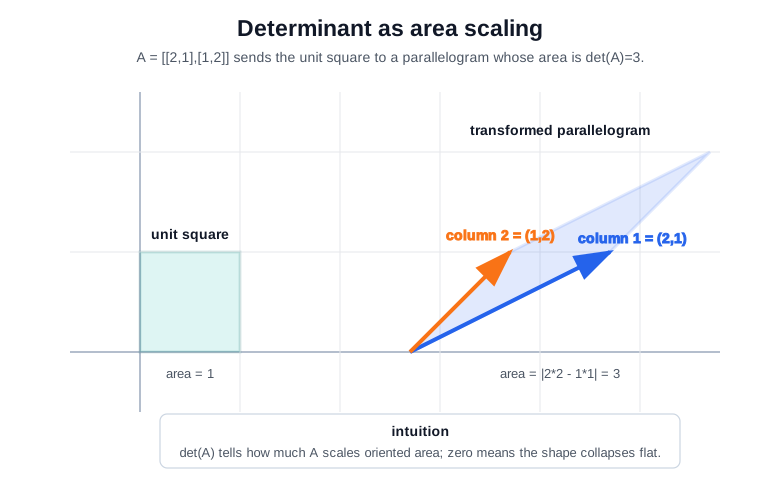
This is the same matrix used on Eigenvalues and Eigenvectors. There, the eigenvalues are and ; their product is also the determinant:
For diagonalizable matrices, the determinant is the product of eigenvalues because each eigenvalue is a stretch factor along an eigenvector direction.
Intuition
The determinant answers: “How much does this square matrix scale full-dimensional volume?”
- doubles oriented volume.
- doubles volume and flips orientation.
- preserves volume, though it may shear or rotate.
- collapses volume to zero, so some independent direction is lost.
That last case is the key connection to rank. If a matrix collapses a square into a line, or a cube into a plane, its columns are dependent and it cannot be inverted.
Caveats
Determinants are conceptually important but numerically blunt. In higher dimensions, determinants can become extremely large or small, and a nonzero determinant does not by itself say whether a matrix is well-conditioned. For numerical stability, singular values and condition numbers are usually more informative than determinant magnitude.
References
Nav