V-JEPA 2
V-JEPA 2 is a scaled self-supervised video model in the JEPA family. The paper frames it around video understanding, prediction, and planning, including a latent action-conditioned variant for robot planning. It should be read as a world models research direction, not as proof that the model has complete physical understanding.
Latent prediction for planning
The representation-learning core follows V-JEPA: predict masked or future latent representations from visible context. For planning, an action-conditioned latent dynamics model can score candidate actions:
That objective is different from a video-language model, which aligns video tokens to text.
Backbone Pipeline
A V-JEPA 2-style video backbone can be understood as a video-transformer pipeline:
- Convert a video tensor into tubelet tokens with a 3D patch embedding.
- Preserve each token’s original address.
- Apply positional geometry, such as rotary position embeddings, to queries and keys.
- Run transformer encoder blocks over contextualized tubelet tokens.
- Use the resulting latent tokens for prediction, probing, or downstream planning.
During self-supervised pretraining, the model does not need gesture labels or a classifier head. The context encoder sees visible tubelets, a predictor estimates hidden target latents, and a target encoder supplies stop-gradient latent targets. During transfer, the backbone may be frozen and a small probe head can test whether those latent tokens already separate a downstream task such as gesture recognition.
Tubelets And RoPE
For a video , a tubelet is a small block of adjacent frames and spatial pixels. With tubelet length and patch size , token covers
A 3D patch embedding flattens that block and projects it into a token:
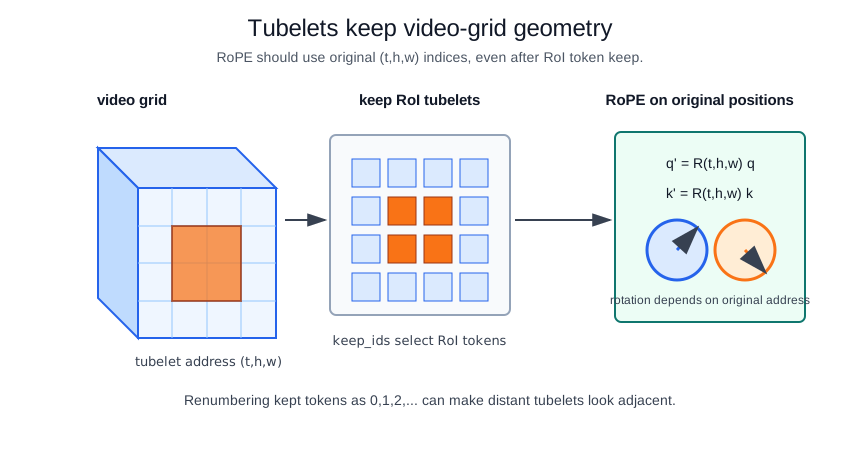
The token keeps its original address . That address matters because attention needs positional geometry. Rotary position embeddings (RoPE) rotate query and key coordinates by position-dependent angles. For one two-dimensional feature pair at scalar position ,
For video tokens, the position is multidimensional, so implementations apply temporal and spatial rotations using the original tubelet coordinates:
Attention then uses the rotated queries and keys:
RoPE does not detect motion by itself. It gives attention access to relative temporal and spatial offsets so the model can learn motion-sensitive interactions between tubelets.
Masking Versus Token Keeping
Two operations are easy to confuse:
| operation | when it happens | what it means |
|---|---|---|
| JEPA target masking | Self-supervised pretraining | Hide target tubelets and predict their target-encoder latent representations from visible context. |
| Inference-time token keep | Downstream adaptation or efficiency | Physically keep a subset of tokens, such as person- or hand-region tubelets, before later attention or probing. |
The first is a learning objective. The second is an input-domain or compute-budget choice. If RoI tokens are kept after patch embedding, the kept tokens still need positional encodings based on their original video-grid indices. Replacing original indices with dense post-gather indices can make two physically different tubelets look artificially adjacent.
Frozen-Backbone Probing
For a frozen checkpoint, a probe head is a measurement instrument. If a lightweight cross-attention or pooling head separates gesture classes, the backbone representation already carries useful motion or body-state information. If full-frame clips underperform person RoI clips, the failure may be input-domain alignment rather than a lack of temporal representation capacity.
Worked planning example
A latent planner scores candidate actions by rolling them one step forward and comparing the predicted latent state with a goal latent. With current state , goal , and simple transition , the candidate costs are:
| action | predicted next latent | squared distance to goal |
|---|---|---|
The action that moves right has the lowest latent cost, so it would be selected. Real V-JEPA 2-style planning uses learned latents and learned dynamics rather than this hand-coded transition.
Caveats
Planning claims depend on the action-conditioned model, the data distribution, and the evaluation environment. Latent rollouts can be useful without being faithful physical simulation. Keep the distinction clear when comparing to V-JEPA 2 versus Vision-Language Models: V-JEPA 2 is not inherently a conversational model.
References
- Assran et al., 2025, V-JEPA 2: Self-Supervised Video Models Enable Understanding, Prediction and Planning
- Bardes et al., 2024, Revisiting Feature Prediction for Learning Visual Representations from Video
Nav